
ROOTS / A PERSONAL ESSAY
The question I kept asking through another degree
By Kyle Patrick MPA/MSW
Halfway through my second master’s degree, I realized I was trying to earn something no university could award me: the feeling of being loved by my parents.
I was sober. I had gone back to school and become the first person in my family to earn a college education. Yet underneath the next assignment and the next degree was a question I had been carrying for years.
Do you love me yet?
My parents said they loved me. I wanted so badly to feel those words. The unspoken messages around being gay told me that something about me was bad and unlovable. I knew I was gay when I was five. For years, I did not feel safe sharing that part of myself with them.
My mother praised me when I earned high grades or received recognition at school. She bragged about my achievements. At other times, she physically and verbally attacked me. I felt as though I was walking on eggshells.
We all felt it. My dad and my siblings knew when the switch was on or off for Mom. Living with that changeability taught me to understand love and acceptance as conditional: follow the rules, don’t create stress, and you can be lovable.
Her approval also reached into my friendships. She approved of certain friends and called others losers. Her sibling rivalry with her older brother spilled into how she saw his children. She believed my cousins were a bad influence on me.
Those cousins loved me, accepted me, and never hurt me. They were the first family members I came out to. I remember them saying, “Kyle, we have known this about you forever, and we never thought any differently of you. Your heart should already know that.” They kept it private until I was fully out.
It was true. They had never questioned me or treated me differently. They made gay jokes and loved me at the same time. Hell, I made the gay jokes too. One of my cousins is a big butch lesbian, so we’re just out here in full effect.
There is a name for affection that depends on meeting expectations: parental conditional regard. Research has linked it with internal pressure and fluctuating self-esteem. [1] In my life, the rule about being lovable became something I carried into how I treated myself.
There were also plenty of things I had fucked up. I was living with the effects of fifteen years of sexual abuse and secrecy, and the pain found its way into my rebellion and self-sabotage. In high school, I was at the top of my class scholastically while constantly getting into trouble for ditching school, drinking, and using drugs.
By my senior year, I was strung out on meth and huffing carburetor cleaner. I had been awarded a full-ride scholarship to any university in Arizona. When you are strung out on drugs, scholarships don’t last long. I lost mine. In my twenties, I was in and out of jail with multiple DUIs.
I remember my mother telling me, “You’re so stupid.” As if I hadn’t already told myself that a thousand times. Being academically capable had not stopped me from struggling, or from coming to see my struggles as evidence against myself.
At twenty-five, my mother asked whether I was gay. I told her:
“Yes, and I am proud of who I am. It’s interesting that you are just now asking me this at the age of twenty-five when I have known this since I was five but never felt safe sharing it with you. I guess that shows how much you actually know me.”
She told me she hadn’t raised me this way. I was never to bring a man around the family. I had to move out of the house.
I had said I was proud of who I was, and I meant it. I also wanted my mother to know me and love me. Being able to speak that truth did not make her response painless.
Years of therapy helped me heal. With about five years of sobriety, I was more focused on the solution than on the problem. When I returned to school in my thirties, I was thinking, “I am going to redeem myself.” That belief brought the hope of earning my parents’ acceptance into the new life I was building.
I enrolled at Arizona State University and earned a B.S. in Family and Human Development. I was the first in my family to earn a college education. My parents celebrated my achievement. I still felt that I wasn’t quite lovable enough.
Somehow, that feeling became another plan: if I earned a master’s degree, they would see my value and love me. About two years later, I earned a Master of Public Administration from the University of Phoenix.
They sent me a postcard in the mail. “Congrats! Love mom and dad.”
Yeah. That didn’t do it for me. If I describe the response I had hoped for, it would not have been a postcard. It would have been an invitation to lunch or dinner with them. I wanted time together and a reminder that they loved me no matter what, with some acknowledgment that it might have been hard for me to believe that.
I wanted their words to reach the part of me that still remembered what love could cost. A degree could give them another achievement to celebrate. I was hoping it would also change how being their son felt.
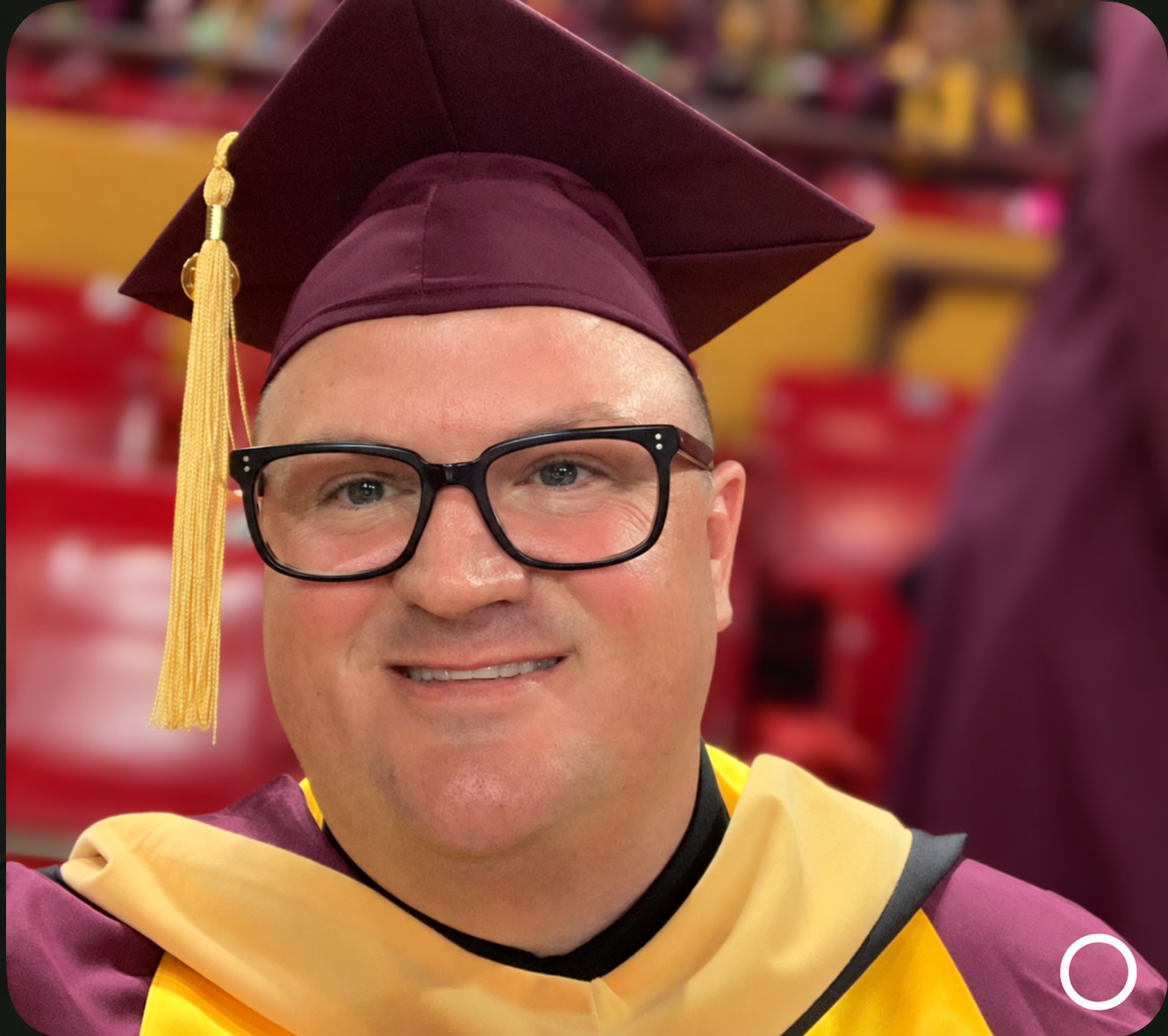
Kyle Patrick at graduation. Photograph supplied by the editor.
So I had another bright idea. If I earned a second master’s degree, they would finally see my value and love me. I enrolled in the Master of Social Work program at Arizona State University.
Research with young sexual minority men has found self-worth tied to academics, appearance, and competition, with longer early concealment linked to greater investment in those areas. [2] For me, achievement had become a place to keep looking for acceptance.
About halfway through that second master’s program, I recognized the belief system keeping me at it. In therapy, I began to understand that I could simply love and accept myself, and that other people could love and accept me too. I did not have to keep proving that I qualified.
I started feeling into a belief I still carry: “I know my value and I don’t give discounts.” Just about then, my motivation for school dropped. If a degree wasn’t going to prove my worth and gain my parents’ love, what was the point?
That is the awkward part of realizing you've been trying to earn love: the effort may have built real things you value. The education mattered. So did sobriety and the work of returning to school. I needed a reason to keep going that could survive an ordinary response from my parents. Otherwise, their reaction would still be deciding what my achievement meant.
I had to work diligently to find a reason to continue that belonged to me. I wanted freedom, creativity, and security. I wanted to earn something that could never be taken away from me. Those desires gave me something to pursue beyond the response I hoped to receive from my parents.
I always ask, “How much does a dream cost?” There’s no limit, right? Well, mine cost me $250,000 in student loan debt. I joke that even if I never manage to pay it all off, they can’t repossess my diplomas.
Research with Israeli teenagers found a difference between striving under pressure and learning with a sense of choice. Conditional approval was linked to inner compulsion; support for autonomy was linked to interest. [3] My experience was an adult one, but finding my own reasons to stay mattered.
That shift also changes the question we bring to an achievement. Instead of asking whether it has finally made us acceptable, we can ask what it allows us to do. The answer might be work we care about, a little more independence, or choices we didn't have before. Those things can matter even when the people whose approval we wanted never respond as we hoped.
Looking at my Roots also meant taking seriously the love that had already shown up. My cousins have been to Pride and gay bars with me. When they met an ex of mine, they were like, “Okay, no.” Years later, when they met my husband, they gave him the seal of approval.
They welcomed us both into family gatherings and attended our wedding. Once, we happened to be in Chicago at the same time and met up. They have stood up for me at family gatherings I didn’t attend, when other relatives shared their opinions about who they thought I was.
“Your heart should already know that.” It did. Their words matched how they had treated me. The people my mother considered a bad influence had given me a place to belong.
Today, I can accept my parents’ words of “I love you” while honoring the limit of what those words give me. They still do not touch my heart in all the ways I had hoped they would. Learning to love myself has allowed me to be honest about that without making my value depend on their words feeling different.
There is room to grieve what we wanted from our parents and still receive what other people offer. One relationship doesn't have to stand trial for another's failures. My cousins' love counts. So does my husband's. So does the life I have worked to build, even where the old question still hurts.
For years, I kept trying to become someone my parents’ love would finally reach. Therapy helped me understand that I could love the person who was already here. I am no longer asking another degree to answer the question for them.

Responses